Spec Battle: Sharp Aquos Qled Tv 4T C55Hp7050U vs Amazon Fire Tv Omni Qled 2025 — Is It Worth Upgrading?
Introduction
The modern TV market is a fast-moving ecosystem where panel technology, smart platforms, and gaming-ready features evolve every year. Two names that represent different approaches to the living-room experience are the Sharp Aquos QLED Tv 4T C55Hp7050U and the Amazon Fire TV Omni QLED 2025. One emphasizes Sharp’s display engineering and Aquos heritage; the other centers the Amazon Fire TV smart platform and deep integration with the Alexa ecosystem. This article examines both models through real-world use cases—movie watching, sports, gaming, and everyday streaming—and offers a practical buying guide so buyers can decide whether an upgrade makes sense for their needs.
How to read this comparison
This evaluation focuses on categories that matter to typical buyers: picture performance (color, contrast, HDR), motion handling, smart platform and ecosystem, gaming features, audio, ports and connectivity, and day-to-day usability. Where specific manufacturer claims matter, the analysis notes them, but the emphasis is on how each TV performs in realistic living-room conditions and which buyer profile benefits most from each model.
Detailed product analysis
Sharp Aquos QLED Tv 4T C55Hp7050U — What it aims to deliver
The Sharp Aquos QLED line historically targets buyers who prioritize display quality and color performance at a competitive price. The C55Hp7050U model in the Aquos QLED 4T family positions itself as a value-oriented QLED offering with enhanced color volume, adaptive upscaling, and practical HDR functionality.
Real-world strengths:
- Color and tone mapping: QLED technology in the Aquos tends to produce lively, saturated colors with good volume in bright scenes—useful for animated content and HDR-enabled films where color pop matters.
- Upscaling and motion processing: The Aquos series typically includes a dedicated upscaler and motion-processing algorithms that smooth lower-resolution content and reduce judder in mixed-frame-rate sources, which benefits TV broadcasts and older streaming libraries.
- Design and ergonomics: Models in this range often have clean bezels and a stable stand, making them suitable for typical living-room setups or wall mounting.
Practical trade-offs to expect:
- Peak HDR brightness is often competitive but not always class-leading; in bright rooms it may not match premium mini‑LED alternatives.
- Sharp’s smart platform can vary by market and sometimes feels less fluid than the dominant OS options from Google or Amazon, though the core streaming apps are usually present.
- Audio is serviceable for dialogue and news but audiophiles will likely route TV sound through a soundbar for fuller bass and staging.
Amazon Fire TV Omni QLED 2025 — What it emphasizes
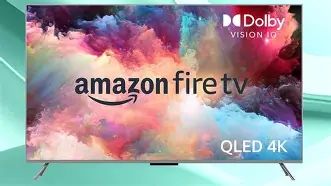
The Fire TV Omni QLED 2025 pivots the product experience around a best-in-class smart ecosystem. Amazon’s Fire TV OS integrates Alexa as a primary voice interface, and the hardware is designed to provide a frictionless, app-rich streaming experience with tight access to Amazon services. The 2025 iteration pushes QLED panels into the Omni family to improve picture quality while preserving the platform’s strengths.
Real-world strengths:
- Smart platform integration: Fire TV is widely recognized for its intuitive navigation, voice control through Alexa, and frequent software updates—especially attractive for households invested in Amazon devices.
- User convenience: Features like ambient mode, integrated smart home controls, and cross-device casting make the TV feel like a central hub in a smart-home setup.
- Content discovery and personalization: Fire TV often surfaces tailored recommendations and deep integration with Prime Video, which speeds up finding new content.
Practical trade-offs to expect:
- Some users find the platform promotes content suggestions and shortcuts toward Amazon services more aggressively than other OSes.
- While picture quality has improved with QLED panels, the Fire TV Omni focuses less on fine-grain display calibration options compared with display-first brands.
- As with most thin TV cabinets, built-in speakers provide basic fidelity; pairing with a soundbar is recommended for cinema-like sound.
Comparison table
| Category | Sharp Aquos QLED 4T C55Hp7050U | Amazon Fire TV Omni QLED 2025 |
|---|---|---|
| Display technology | QLED with manufacturer tuning for color saturation and upscaling | QLED panel combined with Fire TV tuning for enhanced everyday picture quality |
| Smart platform | Sharp’s smart TV platform (varies by region); supports mainstream streaming apps | Amazon Fire TV OS with deep Alexa integration and wide app support |
| HDR support | Supports common HDR formats and dynamic tone mapping for improved HDR playback | Supports HDR formats with platform-level enhancements for streaming HDR content |
| Gaming features | Low-latency modes and motion processing; suitable for casual and console gaming | Low-latency modes and smart features for consoles; Fire TV UI handles game streaming well |
| Voice & smart home | Voice support may be included depending on region; integrates with smart devices | Full Alexa support and seamless smart-home controls |
| Audio | Built-in speakers tuned for dialogue; better performance with external audio | Built-in speakers adequate for daily TV use; recommend soundbar for movies |
| Software updates | Periodic updates; frequency varies | Frequent updates and active feature rollouts tied to Fire TV ecosystem |
| Best for | Buyers prioritizing picture tuning and color fidelity on a budget | Buyers invested in Amazon/ Alexa ecosystems and seeking a smooth smart-TV experience |
Pros & cons
Sharp Aquos QLED Tv 4T C55Hp7050U
- Pros:
- QLED color reproduction that emphasizes saturation and vividness
- Competent upscaling and motion handling for diverse content
- Clean, no-frills design that fits typical living-room setups
- Cons:
- Smart platform experience can be less polished or feature-rich than platform-first competitors
- Built-in audio is adequate but not immersive
- HDR peak brightness may be good but not industry-leading in very bright rooms
Amazon Fire TV Omni QLED 2025
- Pros:
- Deep Fire TV and Alexa integration makes navigation and voice control seamless
- Feature-rich smart platform with frequent updates and broad app availability
- Good everyday picture performance with QLED color and platform tuning
- Cons:
- Interface may push Amazon services and recommendations prominently
- Less emphasis on display calibration options for enthusiasts seeking tweaked color accuracy
- Internal speakers are typical for the category and benefit from external audio systems
What buyers typically care about — and how each TV addresses it
Picture quality for movies and streaming
Movie lovers prioritize accurate color, deep blacks, and consistent tone mapping on HDR material. The Sharp Aquos QLED is often tuned to produce eye-catching color and clean upscaling, which benefits SDR-to-HDR-like conversions and vibrant content. The Fire TV Omni QLED balances panel performance with platform-level picture enhancements—useful when streaming directly from services where Fire TV can manage HDR playback and optimization.
Looking for the best TVs & Home Theater deals on Amazon?
See Deals →Sports and live events
For sports, motion clarity, wide viewing angles, and color retention at brightness extremes matter. Both QLED implementations handle fast motion well; the Aquos model’s motion-processing pipeline can make lower-quality broadcasts appear steadier, while the Fire TV Omni benefits from platform optimizations and quick channel/app switching.
Gaming
Gamers look at input lag, VRR, and HDMI bandwidth. Both TVs include low-latency/game modes suitable for console gaming. For competitive PC gamers who require the lowest possible lag and broad HDMI 2.1 feature support, it is essential to confirm the exact HDMI specification of a chosen model before purchase. The practical outcome: both TVs are excellent for console gaming in casual and most competitive scenarios, but buyers should verify specific input-lag numbers and variable-refresh support if that's the primary use case.
Smart home and voice control
Amazon’s Fire TV Omni wins if the household already uses Alexa devices; the seamless handoff between speakers, Echo displays, and the TV provides convenience for smart-home control. Sharp’s Aquos model can integrate with smart-home devices but will typically require additional configuration or rely on third-party assistants depending on the region.
Living-room fit and day-to-day usability
Both TVs are designed for mainstream living rooms. Remote ergonomics, app availability, and occasional software updates determine daily happiness. Fire TV’s remote and UI are often praised for fast access to apps and voice search; Sharp focuses on simple navigation and reliable streaming app support.
Buying guide — how to decide whether to upgrade
Upgrading a TV should be based on practical needs: what the current TV cannot do, how the room is used, and whether new features provide meaningful improvements. The following checklist helps to decide.
1. Assess the pain points of the current TV
- Is the picture washed out in bright rooms? If yes, a newer QLED with improved brightness and color volume may help.
- Are apps slow or missing? If the smart platform feels sluggish or lacks favorite apps, consider a TV with a more current OS.
- Is audio unsatisfactory? If sound is a primary issue, pairing an older TV with a soundbar may be cheaper than investing in a new panel.
2. Define the primary use cases
- Movies and streaming: Prioritize panel performance and HDR handling.
- Sports and live TV: Prioritize motion handling and a bright display.
- Gaming: Prioritize low input lag, HDMI features, and VRR support.
- Smart-home hub: Prioritize Fire TV Omni if Alexa integration is important.
3. Check room conditions
Brightness and viewing angle requirements change with room lighting. If the TV sits opposite large windows or in a sunny living room, higher brightness and anti-reflective screening matter. For dim home theaters, contrast and local dimming are more important.
4. Future proofing and connectivity
Confirm the supported HDMI version, number of HDMI ports, eARC support for audio passthrough, and wireless connectivity (Wi-Fi 6, Bluetooth versions). These determine how well the TV will accommodate new streaming boxes, game consoles, and sound systems over the next several years.
5. Software ecosystem and long-term updates
Software support matters for app updates, security, and feature rollouts. Fire TV has a robust update cadence tied to Amazon’s ecosystem; Sharp’s update frequency varies but typically covers critical app compatibility. Confirm warranty terms and regional support coverage before purchase.
Looking for the best TVs & Home Theater deals on Amazon?
Browse Now →6. Test drive if possible
Where possible, view the models in a store or a showroom. Pay attention to motion rendering, HDR highlights, and the remote’s feel. Bring a familiar video clip or test patterns on a USB drive to check upscaling and shadow detail if the store allows.
Practical recommendations by buyer profile
For movie-focused buyers
If color fidelity and upscaling for streaming libraries are the priority, the Sharp Aquos QLED 4T C55Hp7050U is a compelling option—especially if the price is a deciding factor. Combine with a modest soundbar to create a balanced home-theater setup.
For smart-home and convenience seekers
Buyers invested in Alexa devices or who value immediate access to Amazon content will find the Fire TV Omni QLED 2025 a better fit. The hands-free voice features and Fire TV’s recommendation engine streamline everyday use.
For gamers
Both models are suitable, but competitive gamers should verify specific input-lag and HDMI feature support. If ultra-low latency and the full suite of HDMI 2.1 features are non-negotiable, check the spec sheet or lab reviews for measured input lag and VRR performance before choosing.
For budget-conscious households
Look for discounts and seasonal deals. The Aquos line often gives strong picture performance at a lower price point, while Fire TV Omni models can offer better platform value if bundled features and ecosystem convenience are prioritized.
Conclusion
The Sharp Aquos QLED Tv 4T C55Hp7050U and the Amazon Fire TV Omni QLED 2025 represent two sensible upgrade directions: one prioritizes display quality and color tuning, the other prioritizes a refined smart experience and ecosystem integration. For buyers who want the most engaging picture for movies and mixed-content playback, the Sharp Aquos QLED option is attractive. For households that place a premium on voice control, smart-home convenience, and a streamlined app experience, the Fire TV Omni QLED 2025 is likely the better match.
Ultimately, the decision to upgrade should hinge on concrete needs—better picture quality in a bright room, lower input lag for gaming, or a smarter, more responsive streaming interface. When those needs align with the strengths of either TV, the upgrade is worth considering. Otherwise, modest accessories (soundbars, streaming sticks) or waiting for a seasonal price drop may be the more economical choices.